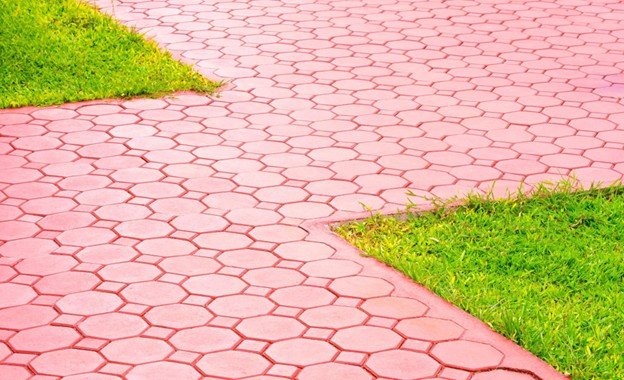
If you’ve walked through the high-end outdoor living spaces in Hidden Lakes or the commercial plazas of Keller Town Center, you’ve seen the work. It looks like expensive Italian slate, weathered timber, or hand-laid cobblestone, but it’s actually a single, seamless slab of concrete.
This is stamped concrete. For many North Texas homeowners, it represents the perfect middle ground between the “plain gray” look of a standard concrete patio and the exorbitant cost of natural stone. But with our local climate challenges and shifting clay soils, is it actually a smart investment?
What Exactly Is Stamped Concrete?
Stamped concrete (often called textured or imprinted concrete) is a specialized finishing technique. Unlike a standard broom finish, we treat the wet concrete as a canvas.
- Coloring: We use “Integral Color” (mixed throughout the batch) and “Color Hardener” (dusted on top) to create depth and realism.
- Stamping: While the concrete is in its “plastic” state, we use heavy-duty rubber mats molded from real stone or wood to imprint the texture.
- Highlighting: We apply “Release Agents” or “Antiquing Washes” that settle into the faux grout lines, giving the slab a three-dimensional, aged look.
This process transforms a structural necessity into a design feature that can mimic nearly any material, including concrete coatings or expensive pavers.
The Financial Breakdown: Is It “Worth It” in Keller?
When determining “value,” you have to look at the Initial Cost vs. Long-Term ROI.
The Initial Investment
In the Tarrant County market, stamped concrete generally costs significantly less than natural stone or brick pavers.
- Natural Stone/Pavers: Requires individual hand-setting, a deep gravel base, and specialized labor.
- Stamped Concrete: Offers the same aesthetic but is poured as a single unit, drastically reducing labor hours.
Property Value & Curb Appeal
In real estate markets like Keller, outdoor living is a high-priority “Checklist Item.” A professionally stamped concrete driveway or patio often yields a 70% to 80% ROI. It signals to buyers that the home has been upgraded with premium materials.
Experience Marker: We’ve seen homes in the Marshall Ridge area sell faster simply because the entryway was upgraded from cracked gray concrete to a stamped “Ashlar Slate” pattern. It creates an immediate “wow factor” that plain concrete can’t match.
Pros and Cons for the North Texas Climate
Before you commit, it is vital to weigh the benefits against the maintenance requirements of the Keller environment.
The Pros
- Customization: You can match your patio exactly to your home’s brick or stone siding.
- Longevity: When reinforced with rebar and a proper base, it handles the Texas “freeze-thaw” cycle better than individual pavers, which often shift or “heave.”
- No Weeds: Because it is a solid slab, you won’t spend your weekends pulling weeds out of grout lines, a common headache with stone pavers.
The Cons
- Maintenance: To keep the colors vibrant, you must reseal the concrete every 2 to 3 years. The Texas sun is brutal on pigments.
- Slippery When Wet: Highly textured or gloss-sealed concrete can be slick near pools. (Note: We combat this at Keller Concrete Pros by adding “Shark Grip” or anti-skid additives to our sealers.
- Visible Cracks: All concrete eventually cracks. While we hide these in “control joints,” a random crack is more visible on a stamped pattern than on a plain slab.
Stamped Concrete vs. Other Options
How does it stack up against the alternatives commonly used by concrete contractors in Keller?
| Feature | Stamped Concrete | Brick/Stone Pavers | Plain Concrete |
| Cost | Moderate | High | Low |
| Durability | High (if sealed) | Moderate (can shift) | High |
| Weed Growth | None | High | None |
| Aesthetics | Excellent | Excellent | Basic |
| Repair Ease | Difficult to match | Easy to swap one | Easy |
If you are currently debating between materials, check out our detailed comparison: Concrete vs. Asphalt Driveways.
The “Hidden” Technical Requirements
In our experience, the difference between a “good” stamped job and a “failing” one comes down to two technical steps many crews skip:
- Subgrade Compaction: Because stamped concrete is an aesthetic investment, you cannot afford for the ground to settle. We use vibrating plate compactors to ensure the Keller clay is rock-solid before the pour. If your ground is already uneven, we may recommend concrete leveling for adjacent structures first.
- Timing the Stamp: If we pour in the hot Texas summer, the “window” for stamping is tiny. If the crew is too slow, the concrete hardens, and the stamps won’t leave a deep enough impression. If they are too fast, the texture becomes blurry.
Frequently Asked Questions (FAQ)
Q: How long does it take to install?
Generally, a stamped project adds 1 to 2 days to the standard installation time due to the detailed coloring and cleaning process.
Q: Will the color fade?
Without a sealer, yes. The UV rays in North Texas will eventually “bleach” the surface. However, a high-quality UV-resistant sealer acts like sunblock, keeping the colors rich for years.
Q: Can I stamp over my existing old concrete?
Usually, no. Stamping requires “fresh” wet concrete. However, we can often apply a stamped overlay, a thin layer of specialized polymer concrete, on top of your existing slab to achieve the same look.
The Verdict: Is It Worth It?
Yes, if you value aesthetics and low maintenance. Stamped concrete is the “Best Value” upgrade for Keller homeowners who want a designer look without the “designer price tag” of masonry. It is the ideal solution for large patios, pool decks, and decorative driveways.